mindingmybiz

This blog is my shared process in working towards integrating self-awareness with all other aspects of life, while on my way to becoming more authentic and whole.

Archive for the tag “children”

The Weight of What Adults Cannot Face
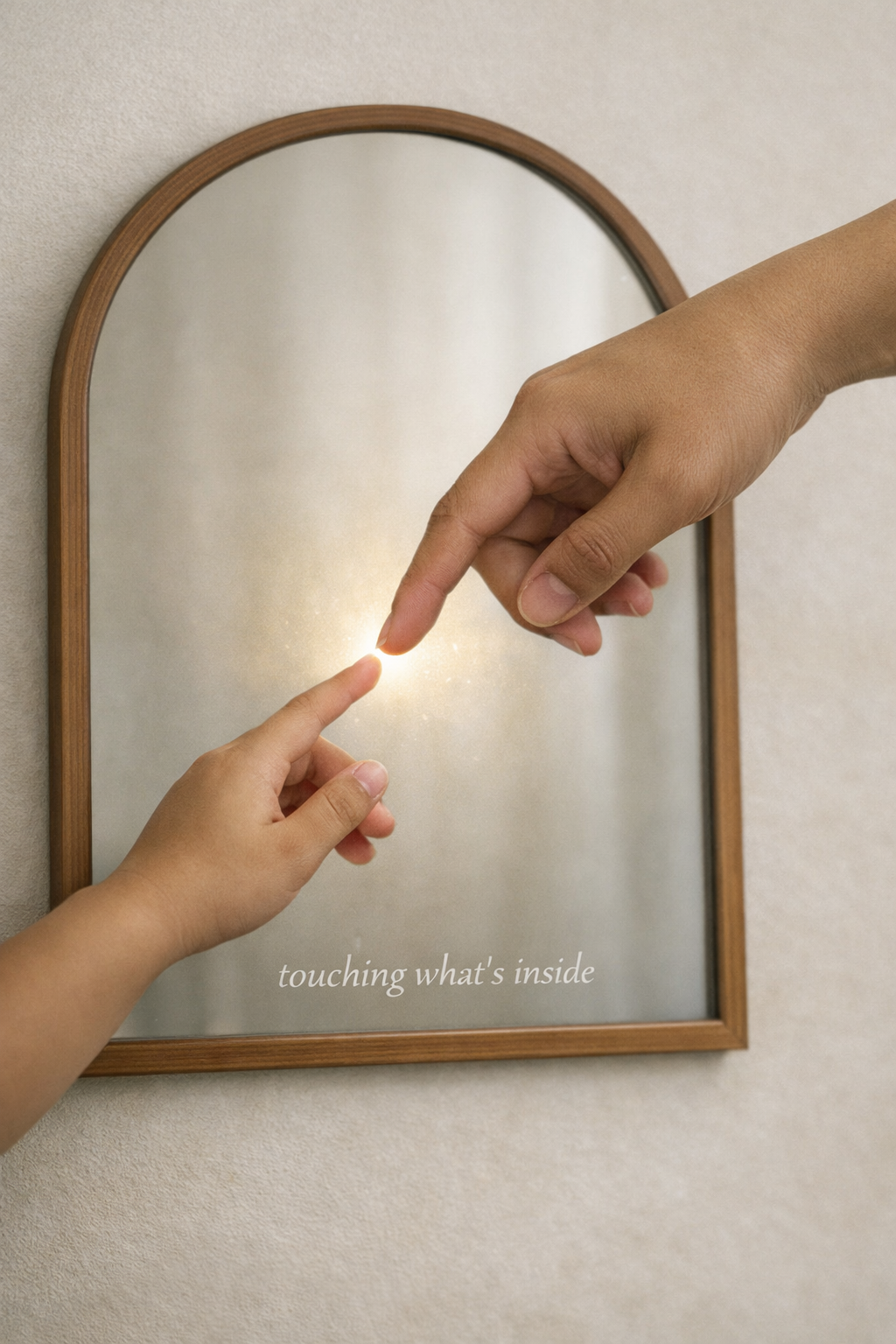
Before children ever blame a parent, they blame themselves. A child will twist themselves into knots to believe their parent is safe, because the truth is too terrifying to hold. And when adults can’t reflect or repair, children assume the fault must be theirs.

Children developmentally interpret disconnect with their parents or other attachment figures as their own doing — and even more so, as evidence that something is wrong with them — especially when shame is induced, implicitly or explicitly. Because children depend on their parents for survival, the idea that a parent cannot provide emotional or intellectual safety is more frightening than believing, “This must be my fault.”

Decades of developmental and attachment research show that when children cannot rely on their parents for emotional, relational, and intellectual care — beyond basic physical needs — it can contribute to developmental trauma.

This isn’t about blaming parents. Most adults are doing the best they can with the capacities, histories, and models they were given. Parenting that extends beyond the physical and material into the emotional, relational, and spiritual realm nurtures children’s developing brains and nervous systems. And when those deeper forms of guidance, attunement, and protection aren’t predictably available or restored, the impact is significant — not because parents are “bad,” but because children are still developing their sense of safety, self, and reality.

If you’d like to explore the research behind this, look up authors such as Daniel Siegel, Tina Payne Bryson, Allan Schore, Peter Fonagy, John Bowlby, and others who have spent decades studying how children develop in the context of relationships.

Spiritually speaking, the non-material aspects of human experience — intellect, emotion, and relationship — require dependable, humble parenting. Some parents struggle to provide this because of their own histories, stressors, or limited support. This is understandable. Parenting is profoundly difficult, and many adults were never shown the emotional skills they now need to give.

At the same time, there are parents who do have access to resources, stability, and support — yet remain highly defended, emotionally unavailable, or unwilling to grow because it doesn’t initially or instantly feel comfortable. This is a different scenario. These patterns are not about poverty, single parenting, or survival stress. They are about rigid defenses that block reflection, repair, and relational responsibility. And this is where my voice steps up as an advocate for children.

When parents repeatedly make relational missteps and do not recognize them, own them, or repair them, the child absorbs the cost. This is not a reflection of the child’s worth or behavior. It reflects a mismatch between what the child developmentally needs and what the parent is willing or able to offer.

When parents leave a void by refusing reflective repair because it’s too uncomfortable — and this persists for years or even decades — something is out of order. To be that out of touch with your children for so long, and for that pattern to ripple into the next generation, is a sign of intergenerational trauma maintained by extremely rigid defenses.

When adults who have been grown for decades still avoid reflective work despite relational fallouts, estrangements, and fractured connections — and instead defend themselves by avoiding or blaming others, including their own children — we’re witnessing something that runs counter to our natural evolutionary instincts to protect and nurture our young beyond material needs.

This usually results in an interpersonal life that does not support close, secure relationships. And yet some continue as if this isn’t a significant enough problem to address.

In contrast:

People who feel discomfort — shame, fear, anxiety, guilt, grief, anger — and choose to self-reflect, change, heal, and grow are demonstrating a courageous and adaptive response that becomes more available in adulthood. This contrast matters, because many people have never encountered it. All they’ve known are individuals who live in defensive extremes.

To be clear: My purpose in writing this is to advocate for children — not to suggest that children should never be challenged, corrected, or held accountable for their missteps. Accountability is essential. But it must be offered in ways that preserve a child’s dignity, understands developmental capacities, and teaches them how to self-reflect, by modeling it yourself — a skill they will need throughout their lives.

As the saying goes: If you give a man a fish, you feed him for a day. If you teach a man how to fish, you feed him for a lifetime.

The same principle applies to children. If you give them rules, expectations, or checklists, you help them for a moment. But if you teach them to think critically and reflectively — rather than merely obediently — you give them a skillset they can use across many contexts throughout their life. You help them build resilience and adaptability for whatever life brings.

Parenting is a long game. It is profoundly difficult to do well — but possible, and deeply rewarding.

May we all learn to reflect more, rely less on defenses, and mind our emotional biz — for the sake of the children in our care.


Innocent Bystanders of Parental Wrath

poison injectionThe unfortunate phenomenon of kids being poisoned by a parent’s (or any adult caretaker’s) rage towards another adult in a kid’s family is so nasty, but all too common.  Why are parents so oblivious to the damage they are inflicting onto their child out of their anger towards someone other than their innocent child?

Seriously.  Wake Up.  Open your eyes and look at who the recipient of your rage really is -your innocent child.  Such seething and reckless anger dangerously injects the wrong target – your children – when it is acted out by them being dragged into something that is really none of their business.  Please – for the sake of these children, own your anger, work through it in conscious, productive, and healthy ways.  Find it worthy to muster up enough courage to get help as needed in order to do this.

Common scenario:  A kid’s parent (or adult caregiver) becomes embittered towards another adult in their child’s life — perhaps their other parent, grandparent, aunt, uncle, etc., and the embittered parent responds by injecting the CHILD with harmful anecdotal accounts portraying the other adult as not loving the child in some way.  This is done to rally support, garner sympathy, and often in older children can nurse a grudge or put a wedge up in between the child and the other adult where there otherwise would not be one, while simultaneously coercing the child to choose loyalties and protect the parent who is in fact the one injecting them with this poisonous vengeance.  This is often done in the guise of being a victim.  It’s highly effective with children because it exploits their innocence, vulnerability, and dependability on the adult who is initiating this tactic.  It’s sickly manipulative when it continues as a pattern after chances to correct and amend it have been neglected.

I realize there are indeed incidents where a parent in a child’s life truly makes the outright decision to abandon and abdicate their rights and responsibilities that come with providing care for their own child.  That is not what I am referring to in this post.  When that happens, the adult(s) that remain in the child’s life who want to support that child need to intentionally provide healing for the abandonment and neglect of the parent that fled.  This often involves sharing the hurtful truth in a sensitive way that is focused on the child’s feelings and self-concept following parental abandonment.  This is not done by emphasizing how the parent who left did not love them or want them.  That is not why a parent fleas, it is because a parent does not have the wherewithal to be a parent.  This has nothing to do with the child’s loveability or worth.  It is about the parent’s extreme limits, not about the limits of the child’s worthiness of love and care.

When one parent is hurt and angry by the other parent, and they turn around and tell their child that daddy or mommy doesn’t love them and want to see them, that is injecting the child with poison because you’re angry at the other parent.  The child is an innocent bystander that has now become the recipient of your wrath.  How is this loving and fair to the child?  It’s not at all.  It is harmful, and though it is hard and often requires a ton of courage and help to avoid doing – it is completely preventable and up to you to take on, for the sake of your own child as well as your own well being.

I get how difficult it is to not act out of spite when you are hurt and feeling completely wronged by your ex or some other adult in your child’s life.  But your child shouldn’t be expected to be so understanding as they get dragged into something they didn’t cause.  They are innocent and do not need to get dragged in the middle.  So please – get help to keep them out of it.  Get honest with yourself.  If you’re struggling to protect your children from your own pain and bitterness, no matter how valid your pain and bitterness may be, it is never valid to throw your child in the midst of it and inject them with poison as you seethe with anger towards your ex or whomever the adult is that you are actually angry at.


Dancing in the Storm of Anger

When-going-gets-tough_painting

There is no contract between me and life that says:

“If you do everything the “right” way, life will go your way.  If it doesn’t go your way, you will be entitled to a settlement which requires life to compensate for it.”

Life. Isn’t. Fair.

Life carries challenges.

Life gives us hard stuff and easy stuff.

I can do everything “right” and the shit can still hit the fan.

As a mother, I am equipping my children to handle all of life’s ups and downs by allowing them to experience the reality of life, with all the good, bad and the ugly.  I will do my best to protect them from pain that I can keep away and teach them to keep away from, but I cannot keep all pain away.  Life has pain, it also has pleasure though.

Shielding my children from all pain is shielding my children from learning important life-lessons.  My best bet is to help them build a tolerance level for pain through teaching and modeling to them how to cope with it. I can provide modeling to my children with how I myself feel pain through grieving, and trusting my body and my God to guide the process in ways that don’t involve harming myself and/or others as part of this process.

Just like me, my children GET to feel angry at whomever or whatever they feel angry at.  But just like me, they don’t GET to express their anger beyond the limits of honoring their own dignity and the dignity of others, at least not without expecting it to be intervened upon through corrective action by me or others.

I want to teach, model and affirm these core-beliefs surrounding anger to serve as a guide in their relationship with anger:

You can learn through practice, to dance with your anger without being struck or stuck by its powerful presence.

  • You CAN feel angry while NOT harming the person you feel angry towards.
  • Anger doesn’t travel solo, there are hidden emotions underneath it, search for them with God’s help.
  • If you think that expressing the emotion of anger only helps you be in control, you will be held hostage by anger.
  • Being angry doesn’t mean being mean.
  • Anger comes in all different shapes and sizes.  Notice when it keeps you from being fully available in your closest relationships, because the more it’s disguised, the more it goes unchecked. The more it goes unchecked, the more the distance will be between you and your loved-one.  Be self-aware or risk being self-deceived.
  • Anger is a normal human emotion.  It is more harmful to resist feeling it, then to allow yourself to feel it.
  • You are not responsible for controlling other people’s anger for them.  Whenever you either volunteer or accept that role, expect disappointment and resentment.
  • Do not hold other people responsible for controlling your anger for you, when you do, expect disappointment and resentment.
  • Expressing big and intense emotions of anger does not mean someone needs to be harmed by them.
  • Others may feel uncomfortable in their own skin while you’re appropriately discharging anger (without harming yourself or others as part of the process), and that is OK.
  • How other people feel in their own skin while you appropriately express your anger has nothing to do with you, but them.
  • Appropriately expressing anger that does not harm self or others is not culturally “normal”, it is hazardous only to the ego or false-self.
  • Whenever possible, express it with those whom you trust and feel emotionally safe with.
  • If you do not feel this is possible with any of the people you are in relationship with, re-evaluate the health of your relationships..healthy relationships can contain anger without being extinguished by it.

Living well involves learning to dance in the storm of anger.  You CAN dance with it and learn to not be overcome or imprisoned by it.  Practice makes progress, and practicing this will serve you well in life.


Post Navigation