mindingmybiz

This blog is my shared process in working towards integrating self-awareness with all other aspects of life, while on my way to becoming more authentic and whole.

Archive for the category “Christianity”

Empirical Spirituality: Two Things

I ventured outside “the church” about 10 years ago. Prior to that, I spent almost 20 years of adulthood in the church.

Leaving the fold started with the ending of my marriage. In retrospect, it could have been said that through my divorce, my ex-husband got the church, and I got the world and the freedom to explore who I was, what I believed, and more importantly how I wanted to live my life and why (not just because the Bible or Jesus says so). This forced me to develop critical thinking and self-reflective skills which emphasized emotional intelligence from the inside-out. This was akin to an overdue internal reset, while raising young children.

Deconstructing my spiritual worldview, which was embedded in fear, gradually ensued.

A persistent fear of an omnipotent evil force ruling the world and my private thoughts was slowly investigated, along with a subtle but persistent fear of abandonment by a more loving but less powerful and erratically intervening God as punishment or mere consequence for not conforming my thinking, believing, and behaving to a set-standard.

Keep in mind – this has been about a 10-year journey, not a rapid and haphazard endeavor. As far as I can tell, this will be a lifelong journey, with different seasons and excursions throughout.

You see, the missing component in my spiritual worldview became apparent – a clear sense of what it meant to be me, according to me.

A slow and careful deconstruction involved my sense of self, which was also, guess what – feared as wholly untrustworthy. That belief had to be closely examined, with support of many trusted others.

The presumption that I was consensually conforming to this worldview from a place of being loved was something I could not grasp. It felt rigidly incoherent. I could not grasp this any longer, nor could I dismiss that I could not grasp it either. So, I tapped out.

Who was I? What did I believe in when it came to relating to the ineffable? How could I even embark on that when I couldn’t fully allow myself to express what was within, what I thought, felt, valued, and why? It all felt backwards. How could I relate to the transcendent when I didn’t know how to relate to the immanent? I often couldn’t clearly define what I felt, thought, and valued for myself. Why? Because I feared and/or disavowed all of that “fleshly” material for the transcendent. Again. Something felt amiss.

Looking back, the only thing I brought with me when I left the church was a curious, searching mindset out to answer something I couldn’t clearly articulate yet. What was I even searching for? I couldn’t have told you.

What I was searching for was a clearer sense of a self – both as a unique individual and as a non-unique human being. How could I truly love or be loved without a clearly sensed self, first? Love involves freely sharing something of the self.

Codependent (vacillating between being overly independent or overly dependent vs. interdependent), fear and shame-based conformity was all I knew. I conflated that with love and faith.

As I moved beyond the confines of the church, I took this one premise for deductive reasoning: God is love.

That’s it.

But what in the actual eff, is love? An apropos question following a divorce, don’t you think?

How do you define, characterize, and identify something that has felt so forsaken, foreign yet natural, innate yet elusive, for much of your life? Another premise was running in the back of my mind and that was this: Whatever I thought I knew about God and love was wrong. I need to start over. Burn the dead trees and see what comes up.

Reflecting on lived experiences, lots of therapy, lots of studying about attachment theory, different spiritual worldviews, along with some inductive reasoning formed by a developing reflective self or put simply: a self, an autonomous self, has helped point to something a lot less foggy.

I decided I needed to explore the world and myself, outside of the codependent relationship I had with religion, within the Evangelical Christian worldview.

As much as possible, I wanted to explore my own spirituality; empirically, autonomously, honestly, and authentically. When I say “spirituality”, I’m referring to how I relate to that which is immaterial and ineffable.

For the first time, I felt a newfound and yet terrifying sense of freedom to explore who I was outside of a belief system that defined my identity and values, the nature of reality, and God, for me. I was now able to discover and develop a more empirical spirituality and identity vs. a theoretical one, for myself.

It was like I was an eager student/scientist when it came to existential angst and humanistic questions that I was now free to ask, test, and not have to immediately settle with answers I had already been given.

This felt both liberating and terrifying. What if I got it all wrong? What if I can’t figure this out on my own? What if, what if, what if?

My divorce provided a sense of “evidence” that what I had believed, how I had perceived myself, God, reality, and life…was missing that foundational piece: A clearer sense of a me. Again – as a unique individual and as a non-unique human being.

Along with my own observations without the fear of hell and the devil overshadowing everything. This was truly the biggest test of faith or of trust in God I had ever taken: leaving the church. It felt like I was leaving “home”. Leaving “Kansas”.

Prayer (or self-talk) with open, honest, and emotionally raw relating did not cease. If anything, it increased. It reminds me of the Psalms of David. He had no “book of Psalms”. He didn’t know he was writing what would someday be used as a hymnal or considered sacred Scripture call “the Psalms”. He was just pouring out his naked heart and soul to God (or himself), uncensored.

This is what I did not leave behind when I left the church. God (which I also define as “Reality” or simply “what is”) cannot be boxed into a church, an idea, a belief, or a label. This is what I refer to as empirical spirituality. I used my ability to observe honestly; internally and externally.

Leaving the church actually helped me become more of an honest observer of life, of myself, and of the hardest age-old questions that still are unanswered. Like why is there so much unjust suffering in this world? A devil, spiritual warfare, and a loving and powerful God who is at war in unseen dimensions does not sufficiently answer that, even if it may be so. Nobody can conclusively prove or verify this, nor can anybody conclusively disconfirm and disprove it either, just like the existence of a Creator God or the non-existence of a Creator God. It is an unanswered question I’ve learned to live with, honestly. It will probably remain as such.

This is how living in faith feels to me; learning to be at peace with uncertainty.

I have read, listened to, worshipped with, visited, conversed with, and digested enough of a diverse plethora of perspectives on religion, theology, epistemology, religious and secular historicity, and psychology to say this:

At the end of the day, I don’t know what the actual facts are about so many things, in the least – what I’ve not borne witness to (like the resurrection or a man named Jesus). Yet, I can say this: only two things really matter.

But first, I have to say this from being such a devout “believer” prior to venturing outside of the church:

What specifically doesn’t matter most is what you (or I) say you (or I) believe in or don’t believe in, when it comes to religious faith, or spirituality, or epistemology.

You can label yourself a Christian, Atheist, Agnostic, Ex-Evangelical, Born-Again, Progressive, Spiritual-but-not-religious, Jew, New Ager, Hippie, Rationalist, Non-Dualist, Buddhist, or Muslim for all I care.

These labels mean very little.

What matters most is how you show up in life, especially in relationships. And this includes the relationship with your very own self, for that replicates in your relationships with others. For example, if you’ve got low tolerance for your own emotions, you’ll probably have a low tolerance for other people’s emotions.

So, what are the characteristics you embody while relating to others?

Simply put: How do you behave towards others?

How do you treat your family, partner, friends, exes, co-parents, ex-friends, co-workers, subordinates, bosses, neighbors, enemies, other people’s kids, people you’ve heard gossiped about, the have’s, the have-nots, acquaintances, people who are not like you, people you disagree with, or people you interact with online?

Of course, the way you relate to others varies immensely depending on context and many variables. There isn’t just one description, there’s complexity.

But in general, consider the people you interact with most – what characterizes how you show up? Or, do you avoid getting close to people?

How do you try to repair the inevitable mishaps in ongoing relationships?

How do you treat people who don’t interact with you regularly? Do you treat them better than those you interact with regularly? Or do you treat them a lot worse? WHY?

That is what matters most to me. It’s what I ask myself constantly.

How much do you care about how you treat people? Your label and beliefs mean very little compared to this.

Secondly: Are you growing?

How are you changing? One thing is constant and unchangeable in life: change itself. While change is inevitable, personal growth is not.

So, are you growing? And, how would you know? What is used to measure this change, merely your own opinion of yourself while you live a relatively isolated life? Ha! That’s a funny one! Especially if you have no record or documentation to track your inner life, your internal dialogue: your thought and emotional life. If you’ve not shared or expressed your inner life over a period of time to anyone, even yourself, i.e. a journal – how can you know any of this with confidence? Don’t fool yourself! Are you relying solely on memory? That is another thing that constantly changes. The story you tell yourself about the past. Your memory might be misleading you without you knowing it. Memory is very limited and bias, depending on mood and cognitive capacity, especially as you age in adulthood.

Don’t get me wrong, you’re definitely a major source of information, but you cannot be the only source with zero accountability or reference checks, so to speak. Who else would be able to answer this, in addition to yourself?

Consider thinking in terms of blocks of several months or years. How have your relationships changed? How has using your time and money changed? How has your perspectives changed?

Are you growing? And how do you know?

Is the only thing that is changing in life, the calendar and the ticking clock?

For me, to answer these questions with more clarity, I had to step outside of the church or a systematic worldview that I conformed to without a clear sense of self. I felt the pull to develop a spirituality that was more empirical. More authentic. More real and meaningful to me. This involved taking detailed notes, journaling in-depth, recording vulnerable discussions within myself/to God, and at times this involved sharing these with another trusted person.

I’ve found that for me, God represents a focus on reality and relationships, including the relationship with oneself, and fosters growth in how I connect with myself and others. In essence, God is reality: that which is or simply exists, empirically rather than theoretically.

The labels, beliefs, canonized books, and whatever interpretations come from ancient, canonized literature all matter little in comparison to those two things. At least, for me.

And one thing is perhaps the icing on the cake: Spiritual community. Authentic spiritual community. Where can I turn to for this? I think I can now turn back to the church. Perhaps, I am more ready to integrate community because I can find enough solidarity within any community as long as those two things have plenty of sunlight, soil, and water for there to be deep growth with others despite differences in mere labels.

Relationships and growth. They go hand in hand, together.

Let’s see what this will bring forth. I am looking forward to this next chapter and in contributing in a meaningful and authentic way. And community that can help foster those two things (which go hand in hand) is good enough for me!

At the end of the day, I will grow…come what may.

On Morality & Love

There’s a story of a man named Simeon in the Bible (see Luke 2:25-35) who was described as being “righteous and devout”.

What does it mean exactly, to be righteous and devout? I’ve got my personal stereotypes and caricatures that portray someone who is “holy”, meaning a bit emotionally cold or stoic, conditionally approachable, not very down-to-earth or relatable, probably intelligent, sophisticated, and rather arrogant. That’s the best description of the image I find that initially emerges into conscious awareness.

Well according to how Jesus answered a teacher of the law, the highest form of morality can be boiled down to love (see Mark 12:29-31). Sequentially and specifically; loving God with your whole inner and integrated being. And then Jesus adds an addendum that seems inseparable to the first command (and that’s much easier to measure) – ‘Love your neighbor as yourself.’

So, I think it’s safe to presume that being righteous and devout means loving an external, metaphysical, ethereal, abstract Being with YOUR whole internal, metaphysical, ethereal, abstract being – measured by an empirically validated and evidenced way – how you treat “your neighbor” as well as yourself.

It’s so simple that we don’t buy it and we often find ourselves adding on a multitude of “morality measurements” with countless other morality clauses than what Jesus added. Just love your neighbors as yourself, that’s hard enough. And your “neighbor” is something else to contemplate in the story of the Good Samaritan in Luke 10, which I won’t go into in this post.

So, the question I’m pondering here is this: How is mental health and development, factored into this command – to love so integratively in a way that it manifests with congruency with other people?

By all appearances and experiences of mine thus far I’m quite sure of this: being loving is not an inborn human trait. Being loving isn’t innately and independently present in human infants. I’ve given birth to and am raising 3 human souls, and I’ve watched them closely.

Now to be clear— being IN NEED of love, at birth and onward is inborn and innate. And when you form a secure attachment and nurture and protect your babies they coo, smile, and affectionately bond with you right back. It’s a beautiful circle of love. But it didn’t begin with the baby first loving me. It started with a baby who needed to be loved and cared for, FIRST.

The nature of the intimate dyad of human caregiving determines (although not exclusively) a great deal in how “loving” a person will eventually be, influenced by how much they themselves felt loved, or more specifically – securely attached.

“Loving” is not to be confused with merely how “nice”, “polite”, socially acceptable, or virtuous they appear in public. This is about way more than mere etiquette. Rather, it’s far more about how much they’ll be able to enjoy consensual and reciprocal vulnerability, authenticity, and work through the inevitable interpersonal conflicts with a selected few. In other words: healthy interpersonal relationships.

In an ideal world, humans would produce loving human beings – generation after generation. It doesn’t take much to see that we don’t live in an ideal world. Far from it.

So if children grow without enough of this kind of emotional secure attachment created within their earliest and formative interpersonal relationships, how can we expect them to give what they don’t have? For so many who didn’t, are we screwed? No. There is a path of healing and inner recovery. God is sensitively attuned to the broken-hearted, who hunger and thirst for righteousness. Just meditate on the Beatitudes in Matthew 5.

I believe humans are biologically wired to be moral creatures. When we are immoral, we suffer and often find ways to escape or find relief from suffering. To be clear again: We are innately moral creatures which means our biology is wired for thriving when we’re morally strong. And I hope I’ve made it clear enough by now that when I say “moral” I mean we’re biologically created to be loved and loving – this is how we’re morally biologically wired – for love, aka to need to give and receive secure emotional attachments. Possessing a familiarity of attachment styles in both childhood and adulthood is helpful to understanding where I’m coming from. Hopefully if you’re making a living within the mental health field or personal development arena, you’re more than a little familiar with the scientific literature on attachment styles and neurobiology. Hopefully.

I digress. Getting back to morality and love…

“We love because he first loved us.” 1 John 4:19

So, to those who perceive themselves as morally righteous, and therefore loving as described above – What is your detailed and coherent, autobiographical narrative that’s made sense of your adulthood in light of your childhood?

In all transparency, this is somewhat of a trick question. I’ve heard people saying they grew up with love and support from their parents, yet these same people are often times some of the quickest to criticize or judge others and are also some of the most emotionally cold or shallow people I know. To be sure, they are often very “nice”, “polite”, socially acceptable, and fluent in practicing social graces/etiquette. Yet, there seems to be a gaping hole, a sense of wtf-ness that’s hard to explain and even harder to convince them of.

Now of course, I could very well be totally off myself here. But the disjointed feeling I get in this wtf-ness experience is because I hear they consider themselves as lucky for growing up the way they did, and therefore they don’t “morally” struggle much. Yet at the same time, I observe that they find it very difficult, unvaluable, and unnecessary (if they even notice) to be emotionally vulnerable, authentic, and show capacity to work through interpersonal conflicts with their loved ones. It’s a head-scratcher for me.

This is the best I can come up with to try and explain the dissonance between morality and love, profoundly the kind of love from God, that pours out interpersonally. Unless you experience it yourself with God, it’s hard to explain to others.

There was a woman who was described in Luke 7:37 as “a woman in that town who lived a sinful life”. She wept on Jesus’ feet (portrays her as probably crawling on the floor in approaching and being next to Jesus) kissed his feet, then wiped his feet with her hair, and poured perfume from an alabaster jar.

To be loved and to love.

I think she gets it.

Intuitively.

Without explanation.

Her story might help shed light on this gaping hole for those who need an explanation. Jesus saw that Simon the Pharisee didn’t get it either.

“Then he turned toward the woman and said to Simon, “Do you see this woman? I came into your house. You did not give me any water for my feet, but she wet my feet with her tears and wiped them with her hair. You did not give me a kiss, but this woman, from the time I entered, has not stopped kissing my feet. You did not put oil on my head, but she has poured perfume on my feet. Therefore, I tell you, her many sins have been forgiven – as her great love has shown. But whoever has been forgiven little loves little.”

Luke 7:44-47

How well you understand the love of God for yourself has much to do with how much you’ve experienced forgiveness from God. And if in your own self-estimation, you don’t have much to be forgiven for, you’ll find it hard to love others who do.

It boils down to compassion. If you don’t have much need for compassion from others, you won’t feel much compassion for others either.

If you’ve never felt much need for love from others, you likely won’t feel much love for others.

Superb Literature Messes With Me

I believe that the Bible contains within its page’s superb literature.  I think it’s superb because I no longer see it telling me what to think, rather it MAKES me think.  It MESSES with me.  It engages with me and I it, deeply and reflectively.  It is provocative literature.

For years now, off and on, I’ve been captivated by the story in Genesis 3, probably because I’ve always journaled this question “what’s wrong with me” ever since I was a teenager.  “Nothing is wrong with you other than that you think something is wrong with you” is the rebuttal.  Yet – that is a judgment that doesn’t completely resonate.  It sounds corrective and even enlightening, but there’s something amiss and dismissive about it.  The truth is, for as long as I can remember, I’ve always felt a subtle disquieted thing in my soul.  It’s hard to explain.  I wrote many pages trying to find out how it got there but the longer I seek insight and wrestle with this, the more I see that this is not a “me” phenomenon.  This is not a “Kristen” issue.  It’s not merely personal, it seems to be universal.  The ancients seemed haunted by this and wrote down a profound story to try and answer “what’s wrong with us?” – that is how I see Genesis 3 in a nutshell.  In other words, I’m not alone in this search.  The ancient ancestors echoed this.  Perhaps this is really a universal and human phenomenon.  This story beautifully illustrates something profound and relatable to me even though it’s a very ancient story.

Yesterday I asked God to help me become less and less offendable over time.  I thought about asking God to make me unoffendable and found several books on Amazon by Christians titled “Unoffendable” but I’m skeptical about the reality or implications of attaining that goal.  I rest in the opinion that only God is truly and purely unoffendable, and Jesus demonstrated this.  Yet for me, at least right now it boasts as too perfectionistic, and not very down to earth.  I see spiritual bypassing to attain that goal, at least for me.  Nonetheless, I’d like to become less easily offended.  I told God that I’m pretty hypocritical in this respect, I have a low tolerance level for people (especially those who are closest to me probably because they mirror certain aspects of my shadow) who are easily offended and take everything so damn personally and react by hiding this fact and lash out at me for their shit.  To be fair, I can admit that I do this too – but not as much as other people I can think of!  Maybe I’m wrong and I need to first look at the log in my own eye…“Why do you see the speck in your brother’s eye, but do not notice the log in your own eye?  Or how can you say to your brother, ‘Let me take the speck out of your eye,’ while the log is in your own eye?  You hypocrite, first take the log out of your own eye, and then you will see clearly to take the speck out of your brother’s eye.”  – Matthew 7:3-5, NRSV   

I digress…irregardless, I told God and myself that I’m offended by how easily offended I am!

This morning these thoughts came… (I swear, I’m a bit obsessed with Genesis 3 again)…

Eating from the tree of knowledge of good and evil is about feeding off the narrative or getting my sense of self or identity or value from moral judgments about others including myself.  Moralizing the Self and others leads to polarizing the Self and others.  Having or possessing judgments versus them having or possessing me is a subtle but very important distinction.  Humility grows with practicing this distinction.


Judgements about good and evil present as “desirable knowledge” that will elevate me.  I do become a bit of a “God in my own image” as I feed my Self with moral judgements.  I forget that I am ummm, NOT GOD.  That role is not well fitted for me because when I take up this role unconsciously, blurred lines cross over into identity. Without humble conscious awareness, this creates relational ruptures within myself and others, to varying degrees. What is more useful is to focus more on judging what I can know to be true or false, for me. 

I cannot know for certain what is right or wrong for others because I cannot perceive for others, objectively.  I have a human bias, specifically I have a “Kristen bias” and you have a “(your name) bias”.  This isn’t “good or bad” but I do believe it is what is, which is truth – simply what is.  

I was listening to a Jordan Peterson podcast and Jonathan Haidt said something that has both struck me and stuck with me along similar lines of Genesis 3!  Mr. Haidt said that “Moralism messes everything up” when Jordan asked him to clarify what he meant by “moralism” Mr. Haidt said “Moralism is that if you look at things in a framework not of true versus false but of right versus wrong, bad versus good, once you put on that frame…Tyler Cowen has a quote somewhere in a Ted Talk he says ‘We think in stories but as soon as you interpret things in a good versus evil story, your IQ drops by 10-15 points’….Arguments become all out war…you lose touch with truth and your goal is to win and strangely you win in ways that alienate the person you are trying to persuade…making your case with moral grandstanding…”  

This really struck me as profound in light of the Genesis 3 story and the symbolic “tree of knowledge of good and evil”.  Today I am witness that eating from this tree creates many problems; the least is of polarization and alienation between intimates and every level of society.  When we receive our sense of identity, meaning, or value from our moral judgments/positions (eating from the tree of knowledge of good and evil), the environment for polarization is ripe. I suppose this is what Jonathan Haidt meant when he said “moralism messes everything up”. It’s not that having moral judgments is problematic, but rather – moralism is not merely possessing moral judgments, but being possessed by them – they are your source of life and identity and defending them starts to cause you to lose touch with a conscious state of what is true and what is false. And I would add what we don’t know is true or false, admitting that is admitting a kind of truth in itself which is ultimately what I’m coming to understand is humility. Owning and making peace with the truth of our human limitations with openness and acceptance is being in harmony with the truth. In contrast being offended and resistant to our limitations (humility) can lead to hiding from the truth within, and when we defend ourselves from owning our truths that we don’t like, there’s a self-rejection/denial that must be defended with something that is not so warm and sincere. This usually leads to being easily offended! Until we lean into and learn from discomfort, it’s a wise teacher.

Now when we intentionally make a move towards finding out what is true or false, not what is right or wrong, good or bad/evil – this will often prove more helpful for human relationships and civilizations to make and maintain progress. 

I’m finding that approaching the bible not as a “moral rules” book is very satisfying to me. It’s a storybook. There are many ancient characters and themes that I find are still relevant and have profound implications for wisdom in daily living.

Lately I’ve been reflecting on what I believe about the Jesus story.  Some believe this is a legendary story birthed out of conspiracy, some believe that this is a historical story based in people giving honest, human (fallible), accounts.  I’m leaning more towards believing the latter, yet that’s why I trust it – its too imperfect to be conspiratorial and because of this I find it provocative and yes, even offensive at times. In some uncanny way this inspires me and touches me, in an ineffable way.

Now I suppose that any of these views on the Jesus story have their own implications. Personally, I believe he was a historical figure that died by means of Roman crucifixion and that the accounts of him being resurrected are honest (imperfect but not conspiratorial) accounts, and that the implications and meaning of this man’s life and death, and his teachings, are still being wrestled with inside myself and many others. I find this Jesus to be akin to how I find the bible; provocative, mysterious, and illuminating. I don’t see much space for retreating in the bunkers of neutrality while engaging with this stuff. So, on one hand, I guess I can understand why people are avoidant or hesitant to engage this fine piece of ancient literature called the bible. Studying the accounts of Jesus and his teachings isn’t “playing it safe”. This ancient literature is compelling to me (and others across time and culture) and forces me to think and reflect deeply about my life and the essence of life itself.

While there are many emotions I feel towards both the bible and Jesus (of which some seem to contradict each other) – indifference is not one of them. This is an area I am not complacent in, and at times I need a break because of that.

Who was Jesus?  Who do others say that he was?  Who do I say that he was?  What are the implications of how I answer these, in the here and now?  These are worth deeply and honestly contemplating for myself and with others who will not either moralize or patronize me, either way.

I am unapologetically ME.

Sorry, but I’m not sorry for being; me.

Though, I will seek to apologize for my reactions which fall below my behavioral standards as I learn to receive or perceive rejection, judgment, and criticism while being WHO I AM. 

External rejection, judgment, and criticism are all welcome, as I consciously welcome MY AUTHENTICITY’S HOMECOMING.

There’s a cost that comes with being who you truly are.  Minimally, it will cost you the loss of temporary approval.  It could cost you more though, rather than just someone’s temporary approval, it could cost you the entire relationship if the foundation is based on you being a certain “you” that is not even really you.

There is also a cost to NOT living authentically.  And this comes through managing the effectiveness of all the ways to numb the pain that is calling you to live in alignment with YOU and to stop living a life in self-betrayal, to varying degrees.

Living inauthentically can cause you to develop a dependency on whatever in life may make you temporarily APPEAR to be secure and self-confident. You will need to invest more and more resources towards appearing this way (to others or yourself) by altering your image or even your own moods in some form to fool yourself, until YOU say – “ENOUGH”. Until then, you may settle with living a deeply insecure life, where you depend entirely on numbing out from this insecure and painful place.

In short – this insecure relationship you have with yourself is built on bullshit, and builds relationships with others built on more bullshit.  For some, a bullshit relationship is the only kind of acceptable relationship. It’s the only way they can feel safe because it’s so damn familiar; showing up in various masks, with familiar scripts. I’ve done this.  I empathize with the masked life. AND, I want more out of life than what my masks can deliver, no matter how sophisticated or glamorous they may look.

One of the masks I most comfortably wore (unconsciously) was this religious mask, mine happened to be “Christian”. While I still loosely identify as a Progressive Christian, hiding behind a rigid religious identity paid off for awhile, until my heart desired more

I’m consciously deconstructing and reconstructing my way of relating to all aspects of me, which is deep spiritual work. It no longer satisfies my soul to turn to a system of religious beliefs and practices defined by others in order to feel acceptable to the Divine and therefore, myself. Because I consciously resonant with the belief that I, as a human being am innately of the Divine.

I’m seeking to be more authentic, not “Christian” or even “spiritual”. This is what I see when I contemplate the life of Jesus or other spiritual beings who lived human lives, which inspire me.

I’ve been on this journey for a little bit. I’m finding that my tolerance level for numbing out and buying into bullshit becomes lower and lower. Simultaneously my appetite for deeper and more authentic connection internally and with others, expands.

I’m practicing authenticity, one imperfect step at a time. For me, this is what it means to be a spiritual being, having my unique human experience.

De-Colonizing Christianity

At a recent local para-Christian ministry meeting, I was reminded of one of the main reasons I left “the church”. Now, once in awhile I’ll attend a church service, but I feel more like an outsider, rather than “one of the flock” and I like it like that for now, and perhaps that won’t ever change.

A home was purchased for the purpose of doing ministry in the community. I think that is a WONDERFUL thing. And the people who were meeting all seemed to have loving and caring hearts, that wanted to reach out to others and help extend the kind of healing they’ve received, to others.

Please note, this is not an attack on the people, this is an attempt to raise awareness on implicit and unconscious biases of a group of people, and there are always exceptions, but my experience didn’t lend to the notion that I was bumping up against an exception, but rather a rule, because of the silence and complicitness within a group of people.

One of the modalities of healing which was shared was of Yoga. There was one very strong and vocal opponent of using Yoga. She is active in something called “Deliverance Ministry” where you deliver people from evil or demonic spirits. She said she had delivered demonic spirits from people who were well advanced into their yoga practice and believed it was in complete opposition to her Christian faith, believing it to be a dangerous practice. This stirred up some tension as there were others in the room in support of yoga. One of the peace-making attempts was initiated by a woman who tried to identify with the woman who was opposed to yoga by saying when she got really into essential oils, this was criticized by other Christians she knew as being “Asian” and the implicit notion was that it therefore, should not be readily accepted by Christians.

Well, I am Asian. Specifically – Korean adopted. I was born in Korea, adopted and raised by White American parents where I was raised “in the church”. Perhaps that’s why I feel so brazen in addressing these heated issues of both race and religion in one post. Part of me feels as though I’m one of them too, who held the same beliefs around Christianity, without being racially self-aware due to a huge lack of race being openly discussed or addressed in my transracially adopted home. It was as if my racial difference didn’t really exist, to the point where I often even forgot I wasn’t White, but Asian. Sorry, I digress, that’s a whole different blog post.

So, I was the only Asian or non-white person in the ministry meeting, and was offended by that microaggression or bordering blatantly racist remark. I spoke up and said “Can I just say, not all Christians are white.” Nobody else commented or responded. The one person who absolutely would have spoken up was on the receiving end of her own microaggressions or scrutiny due to being a yoga instructor. But nobody else spoke up. It’s as if I wasn’t really saying anything anyone else could understand. There was acknowledgment of the offensive talk around the demonization (literally) of yoga, since several others in the group also spoke up and came to the defense of yoga because they’ve had their own positive experiences with yoga, even though from one individual there was a strong resistance and accusation of yoga being “dangerous” partly because it had its roots in India, in Hinduism, this religion that worships false gods and idols, and not the “One True God of the Bible”.

While the following is my interpretation from the not so implicit bias – this is more or less how it came across to me – as implicit racism rearing its ugly but well-disguised “Christian” head asserting its implicit White dominance:

“Yoga does NOT have its origins in the White-European culture, therefore it’s an aberration and is to be feared, thus saith the Lord!”

And it is to this implicit racism I would like to speak quite explicitly to, if you could grant me permission to possibly offend you if you are a White Christian, who is not (in the words of my 13 year old daughter) been “woke” yet.

Granted, I am no Biblical scholar, credentialed theologian, or historian. I am just an average lay person who doesn’t have white skin, who’s intrigued by Jesus, but finds some of his followers, particularly White Christians – very difficult to deal with at times.

Here we go…

Oh – Trigger alert if you have White fragility and if you don’t know what the hell heck that is, you likely have it if any mention of your “Whiteness” as a race triggers you. I’ve learned this is a very fragile space to speak directly to, but for the grace of God, there go I…

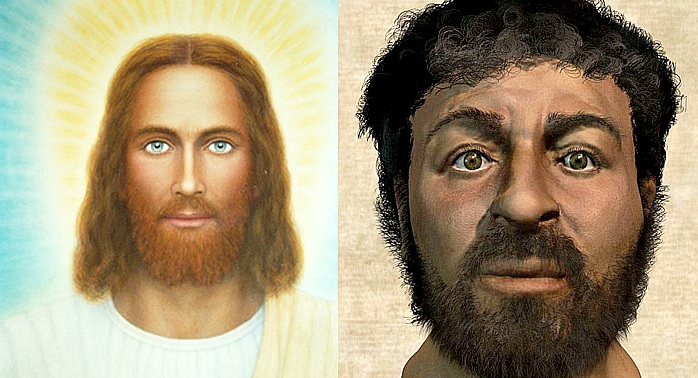
Christianity is not a White-European based religion or faith. Jesus’ race was not of European descent, he was of the Middle Eastern/Northern African region and descent.

Reminder: Jesus was NOT White.

According to forensic scientists, Jesus most likely had dark-brown skin, dark brown eyes, and dark colored hair. And his first disciples were likely not White either. Please, stop colonizing Christianity. Like Yoga, Christianity does not have its origins in White-European culture.

A “false god” or “idol” you may need deliverance from is your White privilege that believes strongly albeit unconsciously, that anything that deviates from White-European based culture, including how one practices their faith (Christian or otherwise) is aberrant, and therefore inferior and to be distrusted. This ego that is implicitly racist, just might be playing the role of a false god, which should probably be humbly examined.

You can build a wall around your White implicitly racist egos, but you cannot isolate god or Jesus to those who look and act like you. But, you can be delivered from this false idol by repenting and turning on the lights to your own fears, insecurities, pain, and defense mechanisms which often scapegoat those for doing just as you do, but don’t look or talk like you. There IS hope for your liberation from White implicit racism. The Lord can help you become “woke” but first you’ll have to stop colonizing and White-washing Christianity.

The abundant life is enjoyed better when you’re awake. But just as the Native American proverb goes – “You can’t wake someone who is pretending to be asleep.”

My words are spoken in an attempt to wake some people up who are dangerously sleepwalking in their racial ignorance combined with their Christianity. I’m willing to assume that it’s not consciously intentional. So, now you can examine it with conscious awareness, if you so choose.

Will you now hit the snooze button and go back to sleep? Or will you stretch, and arise?

Post Navigation