mindingmybiz

This blog is my shared process in working towards integrating self-awareness with all other aspects of life, while on my way to becoming more authentic and whole.

Archive for the tag “healing”

On Emotions

Emotions are part and parcel of being alive and human. They exist for the purpose of survival and flourishing.

Emotions are forces of energy which propel us to take particular actions that are supportive, protective, transformative, and creative.

Yet, just like other forces of nature or energy like heat – their power can range from being productive to destructive.

One of the first things to understand about emotions is that most of our understanding about emotions is flawed. More specifically – misguided, unhelpful, and even harmful.

Emotional literacy is not taught in our schools, nor is it valued. This leaves us far more ignorantly vulnerable and unprotected to the pathological, maladaptive, and misuse of emotions which are incredible sources of energy, power, healing, and innate wisdom.

Instead, we judge ourselves and others for having emotions even though they are a natural part of human evolution. We apply a lens that is restrictive and limiting to our emotions that is dualistic: “right or wrong”, “good or bad”. This makes it a lot harder to do what is evolutionarily intended: to feel them, and if they are intense – to feel and acknowledge them in the presence of supportive and understanding others.

So then – How do things go so awry when it comes to emotions?

Let’s start from the beginning, when humans start to develop. Infancy.

In order for infants to develop optimally – they naturally need and depend on an emotional bond with at least one caregiver that is characterized by a felt experience of: Belonging, reliability, comfort, being delightfully interested in, nurturing, and protection.

This kind of relationship in turn facilitates, understands, and values the preverbal communication of the infant – which is through expression of a range of different emotions.

The infant expresses feelings and needs: physical, social, and psychological. This forms the foundation for the child to develop their sense of who they are (self), in and through their relational experience of feeling enoughness: safe enough, good enough, on a consistently enough basis.

The necessary enoughness involves relational repairs when the inevitable human misattunements occur, which rupture the secure emotional bond from being experienced.

Relational repairs in childhood actually increases the tolerance level for inevitable misattunements and minor emotional injuries by loved ones. This is in a similar fashion to how the immune system develops – through micro exposures to a variety of foreign organisms it’s forced to adapt to, but I digress…

This kind of relational experience with at least one significant caregiver becomes internalized and cultivates how the child comes to see themself, even in a not yet consciously aware way.

This relationally developmental process profoundly influences the initial way the child sees themself and others in the years to come.

So, for better or worse: Young and vulnerable humans (infants) internalize how they are treated, responded to, and reflected back, by caregivers.

How are the inevitable mishaps, misattunements, and miscoordinated interactions by loving but imperfect caregivers handled?

It depends a lot on how the caregiver responds to feeling vulnerable and exposed as imperfect. This is where the difficult but important emotion of shame comes in. How do they respond to feedback that communicates: You’re missing me. You’re not getting it right with me – and it’s important to get it right – which activates some shame go alert for a course correct.

Will the caregiver rigidly defend against feeling shame and vulnerability to making mistakes? Or will they be open to owning that natural although uncomfortable part of being human and learn because shame is a marker that something important is occurring in this moment.

Can they respond to the invitation to reflectively course-correct with compassionate curiosity? This is the gift of within-tolerance-level shame. It alerts us to the inevitable need to course-correct when engaging in something that is important to us, like our relationships.

Course-corrections are a universal aspect of what it means to be human.

Humans are mistake-and-error-makers.

And –

Human are an incredibly teachable species, or we would not have been able to adapt and survive.

This learning or adaptiveness takes place when we are not so hardened to shame.

Self-compassion is an essential protector from intolerable shame which often in turn leads to being defended against or hardened to shame. That just robs us of the opportunity to make adaptive changes and course corrections on this journey called life.


That is my evolving introductory reflections from reading about attachment, affective neuroscience, developmental trauma, and on accelerated experiential dynamic psychotherapy (AEDP) which is a healing oriented approach to therapy.

In deep gratitude I continue to learn and have been profoundly influenced by studying the work of:

  • Diana Fosha
  • Hilary Jacobs Hendle
  • Peter Fonagy
  • Kristin Neff
  • Steven Hayes
  • Daniel Siegel
  • Ed Tronick

Empirical Spirituality: Two Things

I ventured outside “the church” about 10 years ago. Prior to that, I spent almost 20 years of adulthood in the church.

Leaving the fold started with the ending of my marriage. In retrospect, it could have been said that through my divorce, my ex-husband got the church, and I got the world and the freedom to explore who I was, what I believed, and more importantly how I wanted to live my life and why (not just because the Bible or Jesus says so). This forced me to develop critical thinking and self-reflective skills which emphasized emotional intelligence from the inside-out. This was akin to an overdue internal reset, while raising young children.

Deconstructing my spiritual worldview, which was embedded in fear, gradually ensued.

A persistent fear of an omnipotent evil force ruling the world and my private thoughts was slowly investigated, along with a subtle but persistent fear of abandonment by a more loving but less powerful and erratically intervening God as punishment or mere consequence for not conforming my thinking, believing, and behaving to a set-standard.

Keep in mind – this has been about a 10-year journey, not a rapid and haphazard endeavor. As far as I can tell, this will be a lifelong journey, with different seasons and excursions throughout.

You see, the missing component in my spiritual worldview became apparent – a clear sense of what it meant to be me, according to me.

A slow and careful deconstruction involved my sense of self, which was also, guess what – feared as wholly untrustworthy. That belief had to be closely examined, with support of many trusted others.

The presumption that I was consensually conforming to this worldview from a place of being loved was something I could not grasp. It felt rigidly incoherent. I could not grasp this any longer, nor could I dismiss that I could not grasp it either. So, I tapped out.

Who was I? What did I believe in when it came to relating to the ineffable? How could I even embark on that when I couldn’t fully allow myself to express what was within, what I thought, felt, valued, and why? It all felt backwards. How could I relate to the transcendent when I didn’t know how to relate to the immanent? I often couldn’t clearly define what I felt, thought, and valued for myself. Why? Because I feared and/or disavowed all of that “fleshly” material for the transcendent. Again. Something felt amiss.

Looking back, the only thing I brought with me when I left the church was a curious, searching mindset out to answer something I couldn’t clearly articulate yet. What was I even searching for? I couldn’t have told you.

What I was searching for was a clearer sense of a self – both as a unique individual and as a non-unique human being. How could I truly love or be loved without a clearly sensed self, first? Love involves freely sharing something of the self.

Codependent (vacillating between being overly independent or overly dependent vs. interdependent), fear and shame-based conformity was all I knew. I conflated that with love and faith.

As I moved beyond the confines of the church, I took this one premise for deductive reasoning: God is love.

That’s it.

But what in the actual eff, is love? An apropos question following a divorce, don’t you think?

How do you define, characterize, and identify something that has felt so forsaken, foreign yet natural, innate yet elusive, for much of your life? Another premise was running in the back of my mind and that was this: Whatever I thought I knew about God and love was wrong. I need to start over. Burn the dead trees and see what comes up.

Reflecting on lived experiences, lots of therapy, lots of studying about attachment theory, different spiritual worldviews, along with some inductive reasoning formed by a developing reflective self or put simply: a self, an autonomous self, has helped point to something a lot less foggy.

I decided I needed to explore the world and myself, outside of the codependent relationship I had with religion, within the Evangelical Christian worldview.

As much as possible, I wanted to explore my own spirituality; empirically, autonomously, honestly, and authentically. When I say “spirituality”, I’m referring to how I relate to that which is immaterial and ineffable.

For the first time, I felt a newfound and yet terrifying sense of freedom to explore who I was outside of a belief system that defined my identity and values, the nature of reality, and God, for me. I was now able to discover and develop a more empirical spirituality and identity vs. a theoretical one, for myself.

It was like I was an eager student/scientist when it came to existential angst and humanistic questions that I was now free to ask, test, and not have to immediately settle with answers I had already been given.

This felt both liberating and terrifying. What if I got it all wrong? What if I can’t figure this out on my own? What if, what if, what if?

My divorce provided a sense of “evidence” that what I had believed, how I had perceived myself, God, reality, and life…was missing that foundational piece: A clearer sense of a me. Again – as a unique individual and as a non-unique human being.

Along with my own observations without the fear of hell and the devil overshadowing everything. This was truly the biggest test of faith or of trust in God I had ever taken: leaving the church. It felt like I was leaving “home”. Leaving “Kansas”.

Prayer (or self-talk) with open, honest, and emotionally raw relating did not cease. If anything, it increased. It reminds me of the Psalms of David. He had no “book of Psalms”. He didn’t know he was writing what would someday be used as a hymnal or considered sacred Scripture call “the Psalms”. He was just pouring out his naked heart and soul to God (or himself), uncensored.

This is what I did not leave behind when I left the church. God (which I also define as “Reality” or simply “what is”) cannot be boxed into a church, an idea, a belief, or a label. This is what I refer to as empirical spirituality. I used my ability to observe honestly; internally and externally.

Leaving the church actually helped me become more of an honest observer of life, of myself, and of the hardest age-old questions that still are unanswered. Like why is there so much unjust suffering in this world? A devil, spiritual warfare, and a loving and powerful God who is at war in unseen dimensions does not sufficiently answer that, even if it may be so. Nobody can conclusively prove or verify this, nor can anybody conclusively disconfirm and disprove it either, just like the existence of a Creator God or the non-existence of a Creator God. It is an unanswered question I’ve learned to live with, honestly. It will probably remain as such.

This is how living in faith feels to me; learning to be at peace with uncertainty.

I have read, listened to, worshipped with, visited, conversed with, and digested enough of a diverse plethora of perspectives on religion, theology, epistemology, religious and secular historicity, and psychology to say this:

At the end of the day, I don’t know what the actual facts are about so many things, in the least – what I’ve not borne witness to (like the resurrection or a man named Jesus). Yet, I can say this: only two things really matter.

But first, I have to say this from being such a devout “believer” prior to venturing outside of the church:

What specifically doesn’t matter most is what you (or I) say you (or I) believe in or don’t believe in, when it comes to religious faith, or spirituality, or epistemology.

You can label yourself a Christian, Atheist, Agnostic, Ex-Evangelical, Born-Again, Progressive, Spiritual-but-not-religious, Jew, New Ager, Hippie, Rationalist, Non-Dualist, Buddhist, or Muslim for all I care.

These labels mean very little.

What matters most is how you show up in life, especially in relationships. And this includes the relationship with your very own self, for that replicates in your relationships with others. For example, if you’ve got low tolerance for your own emotions, you’ll probably have a low tolerance for other people’s emotions.

So, what are the characteristics you embody while relating to others?

Simply put: How do you behave towards others?

How do you treat your family, partner, friends, exes, co-parents, ex-friends, co-workers, subordinates, bosses, neighbors, enemies, other people’s kids, people you’ve heard gossiped about, the have’s, the have-nots, acquaintances, people who are not like you, people you disagree with, or people you interact with online?

Of course, the way you relate to others varies immensely depending on context and many variables. There isn’t just one description, there’s complexity.

But in general, consider the people you interact with most – what characterizes how you show up? Or, do you avoid getting close to people?

How do you try to repair the inevitable mishaps in ongoing relationships?

How do you treat people who don’t interact with you regularly? Do you treat them better than those you interact with regularly? Or do you treat them a lot worse? WHY?

That is what matters most to me. It’s what I ask myself constantly.

How much do you care about how you treat people? Your label and beliefs mean very little compared to this.

Secondly: Are you growing?

How are you changing? One thing is constant and unchangeable in life: change itself. While change is inevitable, personal growth is not.

So, are you growing? And, how would you know? What is used to measure this change, merely your own opinion of yourself while you live a relatively isolated life? Ha! That’s a funny one! Especially if you have no record or documentation to track your inner life, your internal dialogue: your thought and emotional life. If you’ve not shared or expressed your inner life over a period of time to anyone, even yourself, i.e. a journal – how can you know any of this with confidence? Don’t fool yourself! Are you relying solely on memory? That is another thing that constantly changes. The story you tell yourself about the past. Your memory might be misleading you without you knowing it. Memory is very limited and bias, depending on mood and cognitive capacity, especially as you age in adulthood.

Don’t get me wrong, you’re definitely a major source of information, but you cannot be the only source with zero accountability or reference checks, so to speak. Who else would be able to answer this, in addition to yourself?

Consider thinking in terms of blocks of several months or years. How have your relationships changed? How has using your time and money changed? How has your perspectives changed?

Are you growing? And how do you know?

Is the only thing that is changing in life, the calendar and the ticking clock?

For me, to answer these questions with more clarity, I had to step outside of the church or a systematic worldview that I conformed to without a clear sense of self. I felt the pull to develop a spirituality that was more empirical. More authentic. More real and meaningful to me. This involved taking detailed notes, journaling in-depth, recording vulnerable discussions within myself/to God, and at times this involved sharing these with another trusted person.

I’ve found that for me, God represents a focus on reality and relationships, including the relationship with oneself, and fosters growth in how I connect with myself and others. In essence, God is reality: that which is or simply exists, empirically rather than theoretically.

The labels, beliefs, canonized books, and whatever interpretations come from ancient, canonized literature all matter little in comparison to those two things. At least, for me.

And one thing is perhaps the icing on the cake: Spiritual community. Authentic spiritual community. Where can I turn to for this? I think I can now turn back to the church. Perhaps, I am more ready to integrate community because I can find enough solidarity within any community as long as those two things have plenty of sunlight, soil, and water for there to be deep growth with others despite differences in mere labels.

Relationships and growth. They go hand in hand, together.

Let’s see what this will bring forth. I am looking forward to this next chapter and in contributing in a meaningful and authentic way. And community that can help foster those two things (which go hand in hand) is good enough for me!

At the end of the day, I will grow…come what may.

On Morality & Love

There’s a story of a man named Simeon in the Bible (see Luke 2:25-35) who was described as being “righteous and devout”.

What does it mean exactly, to be righteous and devout? I’ve got my personal stereotypes and caricatures that portray someone who is “holy”, meaning a bit emotionally cold or stoic, conditionally approachable, not very down-to-earth or relatable, probably intelligent, sophisticated, and rather arrogant. That’s the best description of the image I find that initially emerges into conscious awareness.

Well according to how Jesus answered a teacher of the law, the highest form of morality can be boiled down to love (see Mark 12:29-31). Sequentially and specifically; loving God with your whole inner and integrated being. And then Jesus adds an addendum that seems inseparable to the first command (and that’s much easier to measure) – ‘Love your neighbor as yourself.’

So, I think it’s safe to presume that being righteous and devout means loving an external, metaphysical, ethereal, abstract Being with YOUR whole internal, metaphysical, ethereal, abstract being – measured by an empirically validated and evidenced way – how you treat “your neighbor” as well as yourself.

It’s so simple that we don’t buy it and we often find ourselves adding on a multitude of “morality measurements” with countless other morality clauses than what Jesus added. Just love your neighbors as yourself, that’s hard enough. And your “neighbor” is something else to contemplate in the story of the Good Samaritan in Luke 10, which I won’t go into in this post.

So, the question I’m pondering here is this: How is mental health and development, factored into this command – to love so integratively in a way that it manifests with congruency with other people?

By all appearances and experiences of mine thus far I’m quite sure of this: being loving is not an inborn human trait. Being loving isn’t innately and independently present in human infants. I’ve given birth to and am raising 3 human souls, and I’ve watched them closely.

Now to be clear— being IN NEED of love, at birth and onward is inborn and innate. And when you form a secure attachment and nurture and protect your babies they coo, smile, and affectionately bond with you right back. It’s a beautiful circle of love. But it didn’t begin with the baby first loving me. It started with a baby who needed to be loved and cared for, FIRST.

The nature of the intimate dyad of human caregiving determines (although not exclusively) a great deal in how “loving” a person will eventually be, influenced by how much they themselves felt loved, or more specifically – securely attached.

“Loving” is not to be confused with merely how “nice”, “polite”, socially acceptable, or virtuous they appear in public. This is about way more than mere etiquette. Rather, it’s far more about how much they’ll be able to enjoy consensual and reciprocal vulnerability, authenticity, and work through the inevitable interpersonal conflicts with a selected few. In other words: healthy interpersonal relationships.

In an ideal world, humans would produce loving human beings – generation after generation. It doesn’t take much to see that we don’t live in an ideal world. Far from it.

So if children grow without enough of this kind of emotional secure attachment created within their earliest and formative interpersonal relationships, how can we expect them to give what they don’t have? For so many who didn’t, are we screwed? No. There is a path of healing and inner recovery. God is sensitively attuned to the broken-hearted, who hunger and thirst for righteousness. Just meditate on the Beatitudes in Matthew 5.

I believe humans are biologically wired to be moral creatures. When we are immoral, we suffer and often find ways to escape or find relief from suffering. To be clear again: We are innately moral creatures which means our biology is wired for thriving when we’re morally strong. And I hope I’ve made it clear enough by now that when I say “moral” I mean we’re biologically created to be loved and loving – this is how we’re morally biologically wired – for love, aka to need to give and receive secure emotional attachments. Possessing a familiarity of attachment styles in both childhood and adulthood is helpful to understanding where I’m coming from. Hopefully if you’re making a living within the mental health field or personal development arena, you’re more than a little familiar with the scientific literature on attachment styles and neurobiology. Hopefully.

I digress. Getting back to morality and love…

“We love because he first loved us.” 1 John 4:19

So, to those who perceive themselves as morally righteous, and therefore loving as described above – What is your detailed and coherent, autobiographical narrative that’s made sense of your adulthood in light of your childhood?

In all transparency, this is somewhat of a trick question. I’ve heard people saying they grew up with love and support from their parents, yet these same people are often times some of the quickest to criticize or judge others and are also some of the most emotionally cold or shallow people I know. To be sure, they are often very “nice”, “polite”, socially acceptable, and fluent in practicing social graces/etiquette. Yet, there seems to be a gaping hole, a sense of wtf-ness that’s hard to explain and even harder to convince them of.

Now of course, I could very well be totally off myself here. But the disjointed feeling I get in this wtf-ness experience is because I hear they consider themselves as lucky for growing up the way they did, and therefore they don’t “morally” struggle much. Yet at the same time, I observe that they find it very difficult, unvaluable, and unnecessary (if they even notice) to be emotionally vulnerable, authentic, and show capacity to work through interpersonal conflicts with their loved ones. It’s a head-scratcher for me.

This is the best I can come up with to try and explain the dissonance between morality and love, profoundly the kind of love from God, that pours out interpersonally. Unless you experience it yourself with God, it’s hard to explain to others.

There was a woman who was described in Luke 7:37 as “a woman in that town who lived a sinful life”. She wept on Jesus’ feet (portrays her as probably crawling on the floor in approaching and being next to Jesus) kissed his feet, then wiped his feet with her hair, and poured perfume from an alabaster jar.

To be loved and to love.

I think she gets it.

Intuitively.

Without explanation.

Her story might help shed light on this gaping hole for those who need an explanation. Jesus saw that Simon the Pharisee didn’t get it either.

“Then he turned toward the woman and said to Simon, “Do you see this woman? I came into your house. You did not give me any water for my feet, but she wet my feet with her tears and wiped them with her hair. You did not give me a kiss, but this woman, from the time I entered, has not stopped kissing my feet. You did not put oil on my head, but she has poured perfume on my feet. Therefore, I tell you, her many sins have been forgiven – as her great love has shown. But whoever has been forgiven little loves little.”

Luke 7:44-47

How well you understand the love of God for yourself has much to do with how much you’ve experienced forgiveness from God. And if in your own self-estimation, you don’t have much to be forgiven for, you’ll find it hard to love others who do.

It boils down to compassion. If you don’t have much need for compassion from others, you won’t feel much compassion for others either.

If you’ve never felt much need for love from others, you likely won’t feel much love for others.

The Gift of Rejection

I did it again. Practice makes progress in being, me

I felt our collective discomfort but didn’t sell out
In that trance-like, shape-shifting blurring into “not really me”, me

As usual
I wasn’t paid by your approval
I was paid however, by my own

As anticipated, failed approval-seeking came my way
I now know what I didn’t, so I don’t despair
The fear of rejection subsides
So my authentic self doesn’t need to hide

I know in the absence of your approval, is mine
But when I reject my authenticity
I taste it in my gut
I taste it in my soul
And it always leaves a hole

Damn, the anxiety I once felt when falling in that hole
It left such disparity in my soul
In that disparity I found MY soul
But it never truly left me, it was only but an illusion
The absence of your validation doesn’t cause such an ego contusion
Where once forsaken energy can flow, that which truly satisfies me whole


“But, what good is that?”

We’re currently in the midst of a pandemic. “Normal” isn’t happening. In times like these, I find there to be an “illumination effect” in revealing what lurks in the shadows of everyday distractions. Take away the distractions, the daily routines and “normalcy” – you’ll find things you didn’t see or feel so clearly. Or, at least it was more conveniently overlooked. It’s in this space, I wrote this poem regarding my own intimate relationship and taking its pulse, within me.

“But, what good is that?”

I want to share myself as authentically as I can, being fully who I know I am. – With him.

But, what good is that?

I want adventure! I want to be fully awake and alive; spiritually and emotionally, not just physically! – With him.

But, what good is that?

I want to be challenged and stretched graciously yet persistently, to reach for new heights and new depths! – With him.

But, what good is that?

I want to bust free from this goddamn smothering straight-jacket of “status quo” and “fitting in” for crumbs of superficial validation. – With him.

But, what good is that?

I want us to become who we were divinely created to be, not merely who we’ve been “tamed”, “conditioned”, or “raised” to be. – With him.

But, what good is that?

I want to be wildly free, from this cage of mediocrity. – With him.

But, what good is that?

What my heart and soul long for is closeness, beyond merely physicality. – With him.

But, what good is that?

My pursuit and fight for intimacy is a result of an ongoing experience of a partner who resists intimacy, and me resisting his resistance. This is resulting in regression and degeneration – the opposite of what my heart longs for. – With him.

But, what good is that?

Why, do you keep asking me this? I’m trying to have intimacy!

But, what good is that?

The merry-go-round of resistance keeps me from what I’ve been terrified of – acceptance and the grieving through accepting what is. There is shame wrapped up in the grief. This is my inner work of healing, which I’ve been unconsciously avoiding because it’s so damn painful and uncomfortable. We are apart, together. And together, apart.

Go in peace my dear child, grieve. – With me.

Trust the Truth

Dear You,

Please give yourself permission to be convinced of the validity of your unconditional worthiness.

Own the conviction that’s been welling up inside since the moment you existed and has helped you survive so much already despite struggle.  It is clear and uncompromising — this voice will not relent in its conviction:

You have worth.  Always have.  Always will.

Be convinced.

Trust in this conviction — it’s the only thing about you that is unchanging, absolute, and completely real independent of anything else.

Allow yourself to be convinced that this is a stand-alone truth.

It is completely independent of the way other people may see you or treat you, it is an unshakable and unyielding truth that always has been, and always will be — no matter what.  Though the truth is also that the human struggle comes because you’re hardwired to integrate and operate out of being interdependent with your relational and social environments (you are not a rock) which are imperfect, but this truth will still be the truth (the truth is a rock).

Even though as a human you shall inevitably try to fight it, deny it, distort it, swindle it, squander it, prosecute it, overhaul it, or dare to accept it – the truth will not diminish, though your experienced freedom is set on this.

Trust in your worthiness.  Trust in the validity of your worthiness.  This is the spiritual journey back home, to your roots – of unyielding worthiness.  The more you accept this, the more you will enjoy it.  You are meant to enjoy this – your worthiness.

“Then you will know the truth, and the truth will set your free.”
john 8:32

my emerging scattered story

Broken-Mirror-collage-wall-art_thumbI’m in the process of picking up the scattered pieces of my life and trying to make sense out of it, out of me.  Integration.  Cohesiveness.  Wholeness.  In short: Who the fuck am I?  I want to move forward, not backwards.  I seek progression, not regression.  Yet I’m finding an integral part of my goals to moving forward comes with revisiting my past, however many times I need to for resolution.  Each revisit to the past will open up something that’s needed.

In going back to revisit my past, I realize that it feels like I’ve lived several different lives.

My Korean life was the first part of my 11 months of living.  Then after being adopted and coming to the United States at 11 months, I had no place to put that self other than to bury it deeply into an unconscious state.  That was my first “life” that was abruptly ended, without my choosing.  I cut that part away from me.  It was necessary for survival.  That’s survival 101 post-preverbal trauma in a nutshell.  It was obviously not a conscious decision, it happened on its own.  Survival for kids tends to take on a life of its own, without needing conscious permission from anyone.

I entered school as a minority, being raised by White parents.  That in and of itself should explain a lot of things.  If not, try imagining yourself (or your young child if you’re a parent) moving to a foreign country as a child, being raised by adults of a different race and you having a visibly drastic different look than the those who you depend on for survival and are surrounded by everywhere you go.  You’re a kid, you can’t escape it, not even in your own home.

In my adolescence, survival required that I find out who to be so I could fit in.  Seeking social acceptance amongst peers without a foundation of an integrated sense of self in place does things to kids.  Of course the kid wouldn’t know it, few adults seem to grasp it, even though it’s developmentally logical and makes perfect sense if you’re not looking at troubled kids through a lens of disdain through projection based on one’s own fragmented self.  Some adults don’t have that because it was brainwashed out of them through social conditioning towards conformity in their own lives.  Adulthood tends to do this if adults don’t fight the necessary battle to live consciously and authentically.  I have struggled with this pull myself.  It’s a human struggle.

One of my survival tactics when I was an adolescent was to dump all of my White friends and replace them exclusively with Asian friends.  If any of you are reading this now, I am sorry.  It was my attempt at an integrated self, while also trying to survive without a foundation of a coherent self yet.

Adoption has many complexities, and transracial adoption adds even more.  There are many beautiful aspects to adoption.  A child who lost her family and home is given one.  That in and of itself is beautiful.  But let’s not forget or pretend that there would not be an adoption without a traumatic loss preceding it.  Even with all the beautiful parts of adoption ensuing, they will never erase what took place which necessitated the adoption.  Loss.  Loss of what many people take for granted who perhaps were not adopted: family origins, family medical history, a birth mom, a birth father; all vital parts of what forms a human’s identity.  Lost.

Me revisiting parts of the past that I can remember is something I need to do, for me.  There are questions I have that will most likely never be answered.  Never.  That is part of the lost territory that comes with adoption.  I’ve accepted that.  I haven’t had much of a choice to do otherwise and I cannot afford to obsess or rearrange my life around trying to get those answers while abandoning the life I have built for myself in the present tense.  I have my own family now.  But I’m finding that the questions I do have that could be answered by the people I do have access to in my life today, need to be asked.  They may not get answered though, I can’t control that part.

When I was in high school, I hung out with other Koreans, dated an international student from Korea.  It was not a healthy relationship.  How could it be?  I was searching for something I didn’t even know I was searching for, my intangible elusive identity which when looking back, seems like it was playing hide-n-seek with me.  I was an adolescent to boot, of course I was searching for my identity in that relationship.  It was the perfect storm for unconscious longings/losses to arise and resolve.  It makes perfect sense to me.  At least now it does.

When I was in college, I felt myself distancing from my Korean/Asian friends after no longer sharing the bond of drunkenness together.  If any of you are reading this now, I am sorry.  After getting wasted and facing charges of a DWI even though I was honestly innocent, I got just enough conscious awareness to at least wake-up and realize “this is not the life I want, this is not who I want to try to be anymore”.  My search for who I really am, my real self, continued.  So, I joined the church.  I reasoned that even though I was an Asian-American, I was raised by White parents within a predominantly White culture within the church.  I reasoned, why not try to embrace that part of me?  My inner-White girl emerged.

When I joined the church as an active participant and embraced my “believer status” it had several effects on different parts of my life.  In looking back I did not find those experiences to be very integration friendly, at least not beyond theory.  I would not have known any better though, it was my familiar dance…just another version of what I’d lived through before–shoving parts of myself away in order to fit in with an external system.  This period of time in my life formed much of my adult belief system.  I was in my early-mid 20’s, and that is developmentally normal around that age, for anyone.

At this point, I was starting to become a little more sloppy at burying my former identities.  I got so good at survival out of necessity and habit, but it was starting to catch up to me, and yet I continued to do what I felt I needed to do in order to survive within the church social system — to not be condemned (survive).  I became an avid student of the Bible.  I could talk Bible.  I could debate Bible.  I could make myself survive.  I will not deny that a certain part of me was able to emerge and I liked her, I sharpened my intellect through becoming an amatuer feminist theologian, and am damn proud of it.  But, that part of me was still isolated from the other parts.  It became a good way to bury the former parts of me and resurrect ONLY the new “Christian” me, at least I subconsciously reasoned.

I did meet god, in a real, transcendent, and profound way during those years.  Even though I had fragmented identifies all over the place that I wasn’t even remotely aware of, he showed up and came to me.  Yet there were so many divisions between the scattered parts of my own self, it became harder to know which parts of “me” I consciously “allowed” god to meet.

And now present tense, me and god are introducing all parts of my life to one another.  I’m re-introducing parts of my own self to other parts of my own self, and emerging more whole, more integrated, more authentic, one step at a time.  god has always seen all of me, all my parts, the parts I like and take pride in, and the parts I don’t like and wish I could make them go away.  The way I see god and my own unique spirituality is slowly but surely emerging, and it is mine.  I’m learning to not outsource my spirituality while invalidating my own inner wisdom.  It’s my spirituality, it’s my walk with god, not the institutional church’s or an external authority figure’s, I’m taking that back.

Survival is no longer cutting it for me.  I want to be free, I want to live fully.  Therefore, I can no longer hold to the rigid belief system I once had without having doubts.  That was a good way of hiding, of surviving, yet I’m no longer wanting to hide parts of me anymore and only survive, as tempting as that sometimes is just so I can temporarily feel accepted in the moment.  It’s bullshit.  The cost is no longer worth it to me.  I am reconstituting as I integrate within my own self, and I believe this is my lifelong pursuit, my lifelong journey, which includes somehow sharing that with those who get it because they value this for themselves too.

I feel like my soul is coming alive and I will not invalidate it.  It is messy.  It is painful.  But I am worth it and I would not have it any other way.  As you can see, I’ve been there, done that and have found it doesn’t work for me.

This is my emerging story.  What’s yours?

My life is to be continued….

Aloe Vera Transplant

ImageImageImage


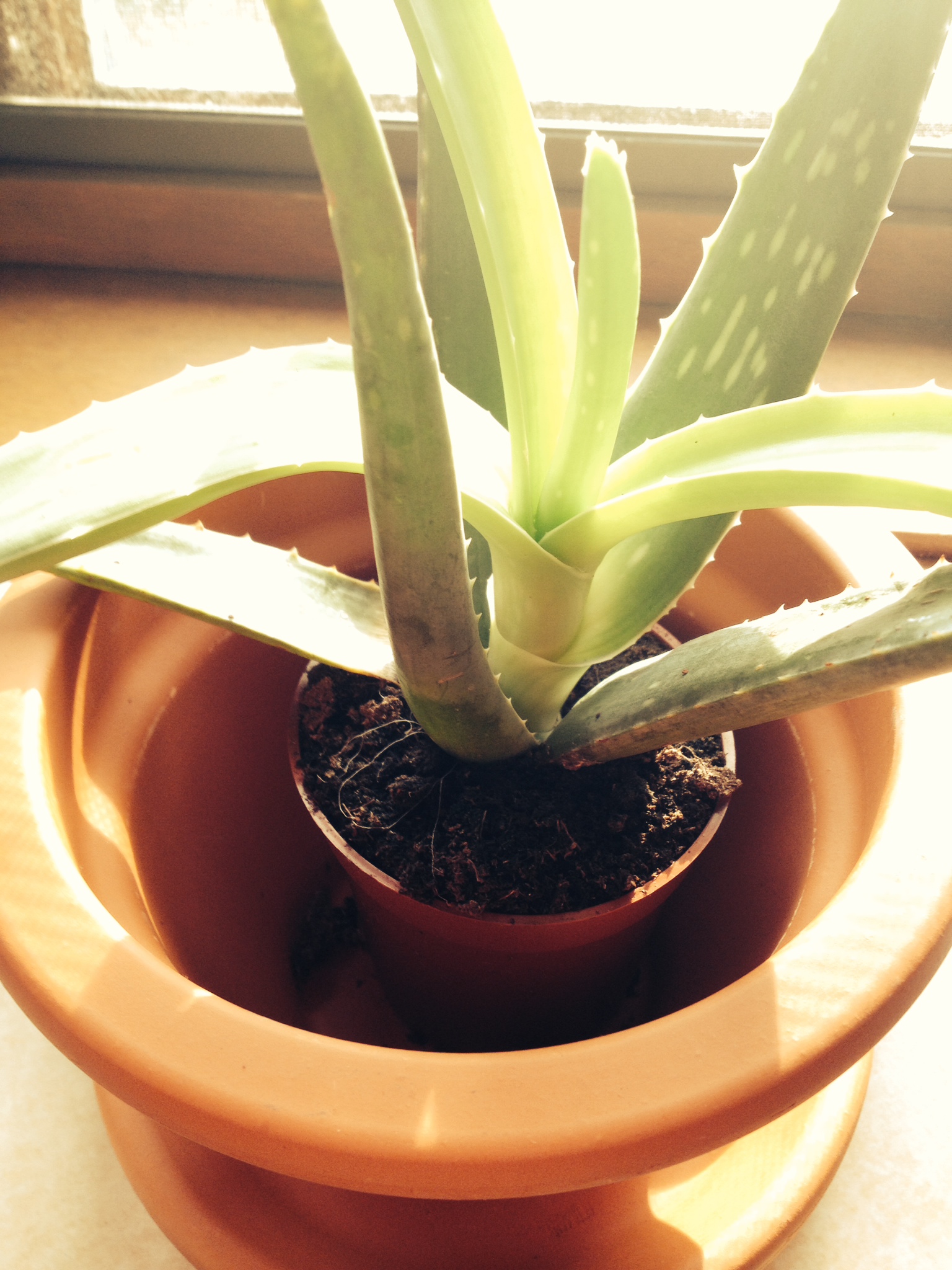
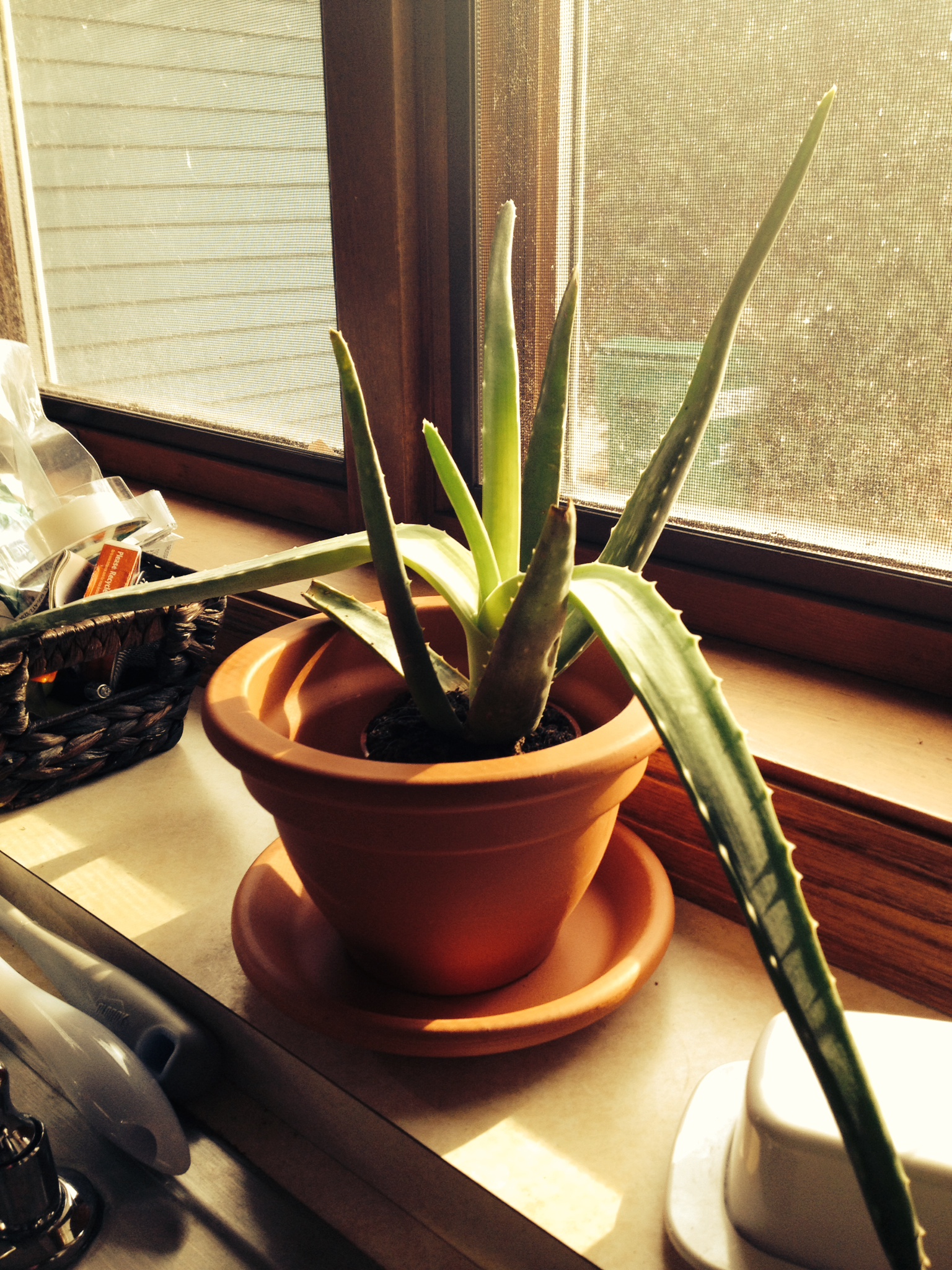
These photos are symbolic of life…

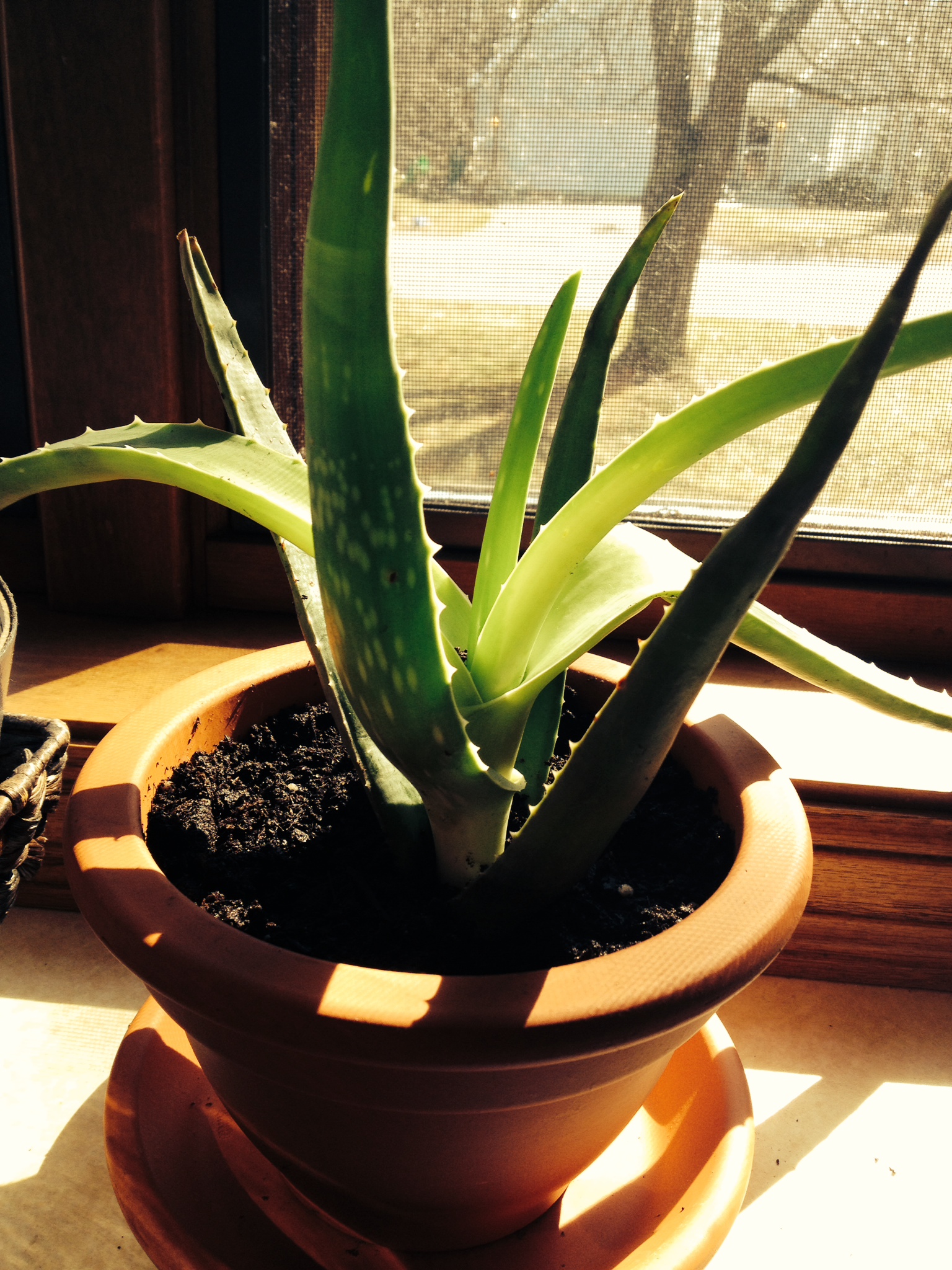
I got an aloe vera plant, which has potential to produce abundant benefits to others.

On the top page, my new aloe vera plant is well established in the small potting plant which was sufficient to get it started, but it is now constraining the plant and cannot allow it to keep growing. If it is not moved to a larger pot, its roots cannot spread out, it will stop growing at best, and at worse die.  This isn’t because its a defective plant, or a defective pot – rather its an ineffective combination given the limits and needs of each other, and their intended purposes.

I need to transfer the aloe vera plant into a larger pot to support its growth so it can be more beneficial to me and others.  The plant must be regularly well cared for, but even if its well watered and kept in sufficient sunlight, it needs to be rooted in an environment that is conducive to its own natural process of growth.

Be kind to your roots, even though the roots are invisible and remain under dirt, they are everything to the plant.

Where can you find a parallel to this in your own life?

Gonna Hear Me Roar

kitty gonna roar

To anyone who wants to listen, listen up…

I am currently listening to blasting  Roar by Katy Perry.

This is so therapeutic for me.

First, I gotta address the haters in my head….the constant critics..

They say, “Why are you blogging as if you’re writing in a private journal entry, but in public?  Don’t air your dirty laundry out in public.  Do it in private, please.”

My response:  I gotta take a shit.

If you’ve been holding in your bowels for years on end and you’re about to burst, you just do it.  My figurative bowels consist of conforming (out of fear) to the majority within my closest psycho-social environment, while constipating anything that poses a possible threat to this goal of conformity, even when it is within my own head.

I’m welcoming a developing condition of enmity to conformity within my psycho-social environments and I need to do it loud and proud.  If not, I am at risk of shrinking back to my previously conditioned default of fear-driven conformity, which is extremely likely the stem of many of my past “mental/mood disorders” and even physical ailments, such as my over-a-decade battle against the voice disorder, MTD (Muscle Tension Dysphonia).

Therefore – an essential part of my own recovery is being out LOUD about it.  Privacy and secrecy are all fine and dandy and serve their legitimate purposes and I will confine myself to those purposes when I determine they serve my recovery best, but I believe they can also be overrated when it comes to healing from shame and fear.

My hope is that me finding my true voice and authentic-self – out LOUD, and lovingly wooing her out of the darkness of shame and fear will provide inspiration, hope and permission for others to embark on the same courageous life-long journey in their own territory.  It’s an uphill battle, and I cannot do it alone, but I alone have got to take the steps to do this.

Peace.

Relational Allergies

Image

When it comes to choosing people to walk closely with in life, I’m discovering I have an aversion to people of any color, shape and size who scapegoat people who are seeking sanity through becoming self-aware and therefore healing in the process.

I am currently experiencing an allergic reaction to people who continue to chose to be unaware of their true-authentic selves.  Not to imperfect people, but to people who are perfectly content with inauthenticity.  Perhaps I will gain an elevated tolerance level for these allergy triggers in time.  But for now, it looks like allergy season is in full effect and I’m discovering what types of personalities I am allergic to in this current season of my own life.

It is essential for me to identify what types of people/relationships I am allergic to.  I will then be able to tailor my daily dose of welcoming people, places and things into my life accordingly.  Only identifying the individual allergens isn’t enough, just as working in a barn when I’ve learned I have hay fever isn’t fitting.  I can expand my recovery-plan to include environments.  Identifying environments that incubate dependencies on my allergy triggers’ environments will serve me well.

I cannot completely avoid interacting with all environments that house my allergic triggers without robbing myself of benefits also, but I can confine my interactions within these environments to be as minimal as possible.  God, give me wisdom to know the difference.

Big picture.  Small Picture.  One Picture.


Post Navigation